
Too Good to Leave, Too Bad to Stay?
If you’ve ever lain awake thinking, “I don’t know if I should stay, and I don’t know if I should go,” and then immediately judged yourself for even having the thought…
Same.
For a long time, I lived in that gray zone.
On paper, my life looked “fine.” I had kids, a career, and a partner. But inside, it felt like I was living two parallel realities: one in which I was committed to making it work, and another in which I was quietly wondering what ending things might be like. And feeling a healthy dose of shame for even thinking that way.
This is something we talk a lot about, and, as longtime readers know, researchers actually have a name for it: relationship ambivalence. It’s a deeply exhausting state where you hold positive and negative feelings about your partner at the same time, and you can’t seem to land anywhere solid.
Time to get personal (because it is)
I didn’t get interested in ambivalence as a cute academic concept. I got interested because I lived it.
“I was once stuck in a deeply…unhappy unhealthy relationship and suffered from relationship ambivalence…for at least 12 years.”
For a long time, I believed staying was “strong.” I grew up with the message that you don’t quit. My parents divorced when I was nine, and I remember thinking: “There’s no way I’m doing that to my children.”
What changed wasn’t a sudden lightning bolt of certainty. It was finally seeing what the stuckness was, teaching my kids what they were learning from the dynamic I was normalizing.
That’s why I’m relentless about this now: ambivalence steals years. Quietly. Politely. While you keep telling yourself you need to try harder.
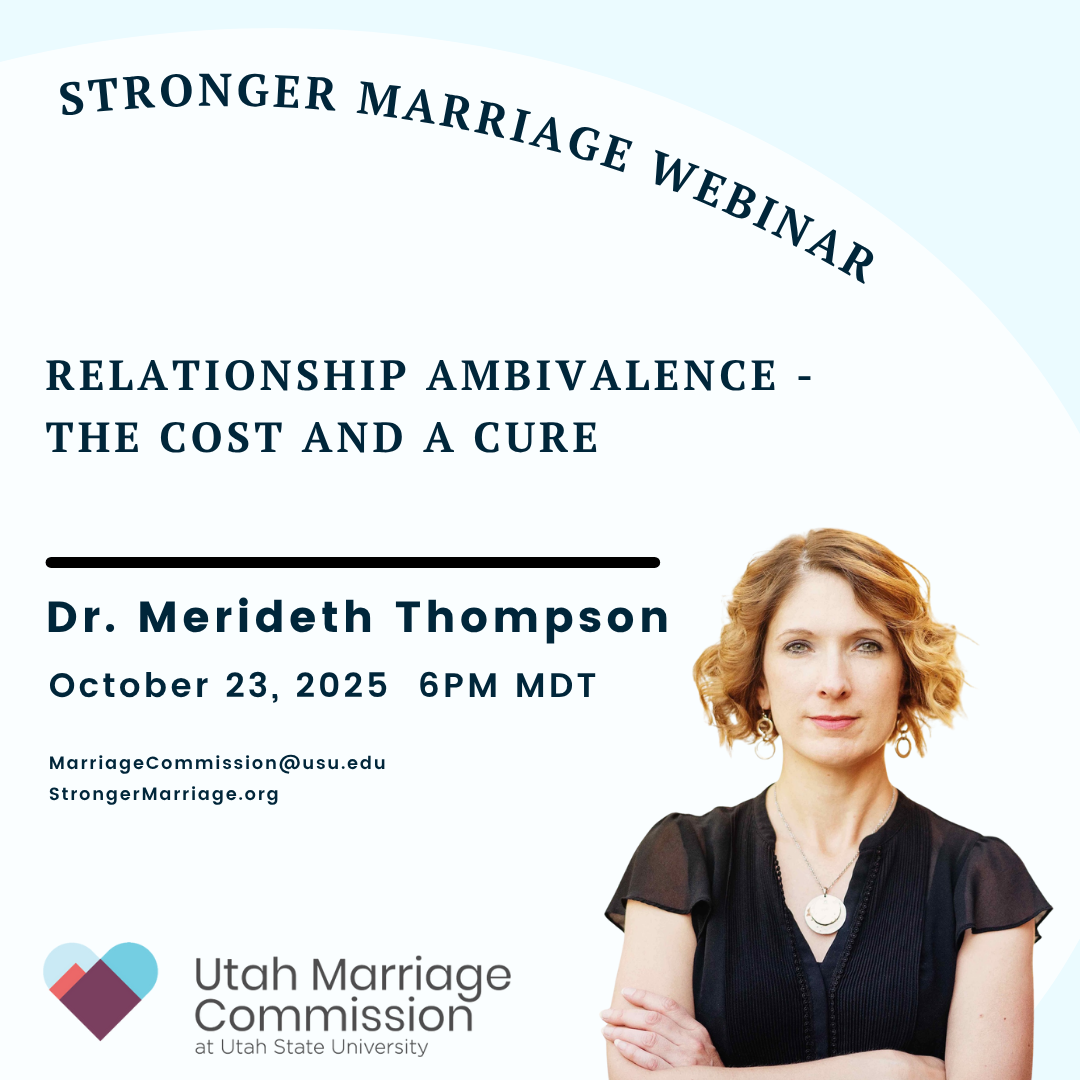
Watch the Full Episode
We discussed this in-depth during a recent webinar with the Utah Marriage Commission.
“A lot of times…we have mixed or contradictory feelings towards a partner… And it generally is…a feeling of being very stuck. It doesn't feel like much of what you do matters.”
You can watch the complete Stronger Marriage episode via the Utah Marriage Commission’s archived webinar form:
What relationship ambivalence is (and why your brain hates it)
Ambivalence isn’t just “mixed feelings.” It’s mixed feelings plus cognitive dissonance—your mind holding two incompatible stories at the same time. In the webinar, I put it this way:
“Our brain continually experiences dissonance and the discomfort of that dissonance and wants to find some sort of resolution for it.”
That’s why ambivalence is so draining. Your nervous system is trying to live in two incompatible futures simultaneously. And research backs up what your body already knows: ambivalence tends to be consequential for both relationship well-being and personal well-being, especially when it’s intense and persistent. PubMed
How common is feeling torn, really?
When you’re ambivalent, your brain loves to whisper: “No one else is this confused.” The numbers disagree.
In a large national longitudinal study of 3,000 married adults (ages 25–50), 25% reported thoughts about divorce in the last six months. (PubMed)
In a “list experiment” study designed to reduce social desirability bias, researchers found about 44% of people in a sample of real-life couples had considered ending their relationship at some point, even though they were still together. (arXiv)
In newlywed research, premarital doubts showed up in at least one partner in two-thirds of couples, and women’s doubts predicted higher divorce rates four years later (even when controlling for other factors). (PubMed)
So if you’re thinking, “I love parts of this, and I’m also deeply unsure,” you’re not a personal failure. You’re having a statistically common human experience.
Why living in limbo hurts so much
Ambivalence doesn’t stay in your thoughts—it shows up in your body, your mood, your parenting, and your capacity to function.
In the webinar, I said it plainly:
“It's not just how you feel about the relationship. It colors how we feel about ourselves.”
1) Ambivalence drains your emotional bandwidth
That constant cycling—hope → disappointment → guilt → overthinking—has real psychological consequences.
Research shows ambivalence is associated with lower well-being. In addition to the 2024 Emotion paper above, another 2025 paper found that when you perceive your partner as ambivalent about you, it’s linked to lower relationship satisfaction and lower personal well-being—in part because the relationship feels less predictable and harder to understand. (Across three studies, total N = 1,135 across the U.S., U.K., and Netherlands.) (PubMed)
Translation: even perceived ambivalence can create a climate of emotional uncertainty that wears people down.
2) Ambivalence can get under your skin—literally
We have decades of evidence that relationship quality and chronic relational stress are associated with health outcomes.
A large meta-analysis in Psychological Bulletin reviewed 126 studies (over 72,000 people) and found that higher marital quality is associated with better physical health outcomes, including markers like blood pressure and even mortality risk (effects are often small-to-moderate, but meaningful at population scale). (PubMed)
And when we zoom in specifically on ambivalent marital ties, research has linked ambivalence patterns to cardiovascular risk indicators—like coronary-artery calcification and blood pressure patterns—suggesting that “mixed and stressful” isn’t just a feeling; it can become a physiological load over time. (PMC)
(Important note: these studies show associations, not destiny. The point isn’t “panic.” The point is: your body is not being dramatic.)
Why quick fixes can create a false sense of clarity
When you’re exhausted, it’s tempting to reach for fast answers: Reddit threads, pop quizzes, “should I leave?” checklists, or even AI-as-therapist.
In the webinar, I warned:
“We cannot outsource clarity. We can't. It's not magic… A lot of times…these quick, simple, low-effort options…create a false sense of clarity…”
Relationships are complex and humans can fall victim to a variety of cognitive distortions. A simplistic answer can accidentally reinforce:
confirmation bias (seeing only what supports your current emotional state),
avoidance (substituting scrolling for real reflection),
over-pathologizing (diagnosing yourself or your partner without clinical training).
One of the lines I come back to often is: “What we avoid we give power to.”
If you want your life back, the path forward usually isn’t another quiz. It’s intentional action.
What actually predicts a healthy relationship (according to 43 studies)
When you’re ambivalent, the “evidence” your brain uses can change day to day:
We had a good weekend—maybe it’s fine.
We fought again—maybe this is hopeless.
This is where research can help you cut through the noise.
A landmark 2020 project pooled data from 43 longitudinal couples studies and used machine learning to identify which self-report factors most robustly predicted relationship quality over time. The top relationship-specific predictors included:
perceived partner commitment
appreciation
sexual satisfaction
perceived partner satisfaction
and conflict (PubMed)
Another powerful finding comes from a meta-analysis on dyadic coping (how couples handle stress together). Across 72 independent samples (nearly 18,000 participants), dyadic coping correlated r = .45 with relationship satisfaction—large in psychological research. (PubMed)
So instead of asking only “Do I still love them?”, research points us toward questions like:
Do we repair after conflict?
Do we face stress as a team—or as opponents?
When I reach for my partner, do they show up with care and presence?
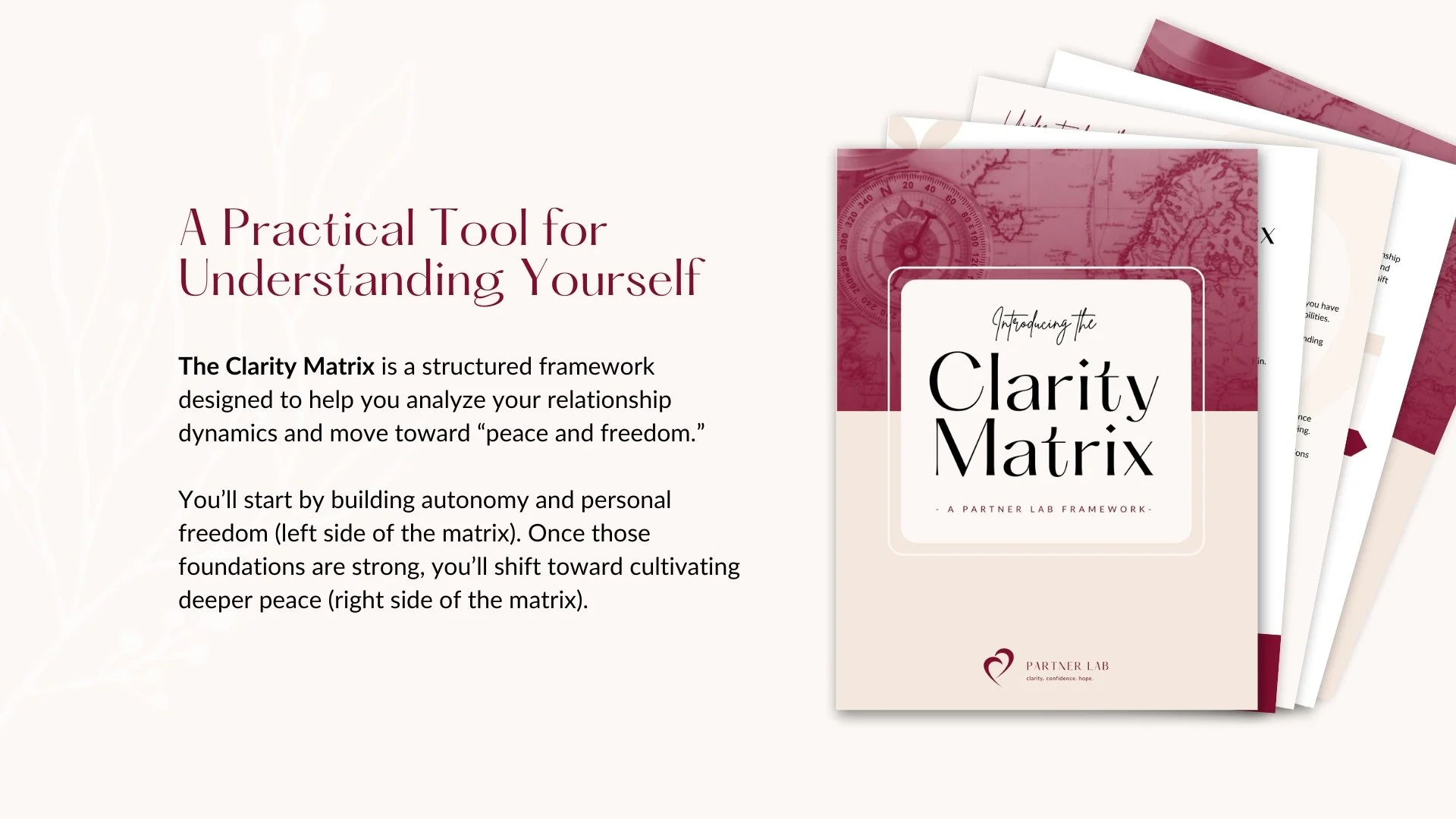
The Clarity Matrix: a way out of the fog
In the webinar, I shared a tool I developed to help people move from ambivalence to clarity: the Clarity Matrix.
It’s built on two deceptively simple questions:
Where do I have influence or control?
Is this pattern having a positive or harmful impact?
That creates four quadrants—each with a different kind of action.
1) Know your deal breakers
Low control + harmful impact
These are behaviors you can’t control and shouldn’t normalize: infidelity, chronic lying, addiction, controlling behavior, or abuse.
As I said in the webinar:
“We don't have a lot of control…But what we can do is…identify, set [a] boundary and then enforce it.”
If you are in an unsafe relationship, clarity also means support and protection—not just self-help.
2) Identify your needs and expectations
Low control + positive impact
Even though you can’t force someone to meet your needs, getting clear about them changes everything.
In the webinar, I highlighted needs that commonly shape relationship quality:
intimacy (“having someone know you really well”)
emotional engagement
companionship
security (“emotional or psychological safety and not chaos or uncertainty”)
And an important reframe:
“We should not expect our partner…to meet all of our needs.”
Clarity isn’t “my partner should be everything.” It’s “what do I need from this relationship, and what do I need from my life?”
3) Claim your freedom
High control + harmful impact
This quadrant is where we stop doing the things that keep us stuck:
living in the past
being trapped by sunk costs (“I’ve invested 20 years…”)
confusing hope with wishful thinking
One of the most resonant parts of the webinar for many people is this:
“Hope…is a double-edged sword.”
Hope can fuel effort and resilience—but if years pass with no evidence of change, hope can quietly become the chain that keeps you in limbo.
4) Grow your peace
High control + positive impact
This is the quadrant where people start to feel like themselves again.
In the webinar, I said:
“Action leads to confidence, whereas inaction leads to anxiety.”
This quadrant includes:
building self-trust (through small, repeated decisions)
strengthening your support network (“power circle”)
reconnecting to your “why”
logging wins (so you can see progress when your brain says you’re failing)
And one of the most practical, body-based insights: “When our body says no, pay attention.”
If you’re feeling torn right now, try this this week
Step 1: Name ambivalence without judging it
Try: “I’m experiencing relationship ambivalence.”
Not: “I’m broken because I can’t decide.”
Step 2: Map your relationship using the Clarity Matrix
Grab paper and write four headings:
Deal breakers (low control / harmful)
Needs & expectations (low control / helpful)
Claim your freedom (high control / harmful)
Grow your peace (high control / helpful)
Then brain-dump honestly under each.
Step 3: Use a research-based tool instead of spiraling alone
This is exactly why we built Clarity360: to give you structure, data, and direction when you’re stuck in “I don’t know.”
Partner Lab’s Clarity360 is designed to use validated relationship science to assess 20+ key areas of relationship health and provide personalized recommendations.
Final word: you deserve clarity—then you deserve peace
You’re not weak for feeling torn.
You’re not selfish for wanting a relationship that feels safe, respectful, and alive.
And you’re not a bad parent for thinking about what kind of love story your kids are watching.
Ambivalence isn’t the enemy. Staying stuck in it forever is.
