
Relationship Ambivalence Is Exhausting. Here’s the Research-Backed Path to Clarity.
Learn the six science-backed factors that actually affect relationship satisfaction and a tool that will help you break out of relationship ambivalence for good.
“When you stay in that ambiguity… once you’re out of it, you’re like, ‘Darn… Those are years I cannot get back.’ I don’t want anybody to have to… live in that any longer than they absolutely have to.
”
If you’ve been cycling through the same question—Should I stay, or is it time to go?—you’re not alone. And you’re not “crazy” for feeling stuck. Relationship ambivalence is a real psychological state, and it can quietly drain your energy, confidence, and sense of self over time.
This blog post is inspired by Dr. Merideth Thompson’s conversation with Dr. Lisa Marie Bobby on Growing Self’s Love, Happiness & Success podcast. If you want the full context (and the full warmth, nuance, and depth of the conversation), watch/listen to the entire episode here:
In this blog post, we’ll pull key quotes and ideas that were discussed in the episode and then add research, statistics, and practical framing—so you can start moving from “spinning” to “steady.”
Why relationship ambivalence feels so destabilizing
Ambivalence isn’t simply indecision. It’s often the simultaneous presence of real reasons to stay and real reasons to leave—plus the emotional cost of living in that unresolved tension.
Newer research suggests that mixed feelings in romantic relationships are common and consequential. In a systematic set of studies on ambivalence and well-being in romantic relationships (4 studies; N = 1,134), ambivalence was associated with lower personal and relationship well-being, especially when people consciously experienced (and reported) feeling torn. (Pure Amsterdam UMC)
That matches what so many people describe privately:
You start questioning your judgment.
You normalize what shouldn’t be normal.
You feel anxious, guilty, or constantly “on watch.”
You lose time—sometimes years—to uncertainty.
“We can question our sanity like, ‘Am I crazy?’… We can develop a lot of distrust in our own ability…”
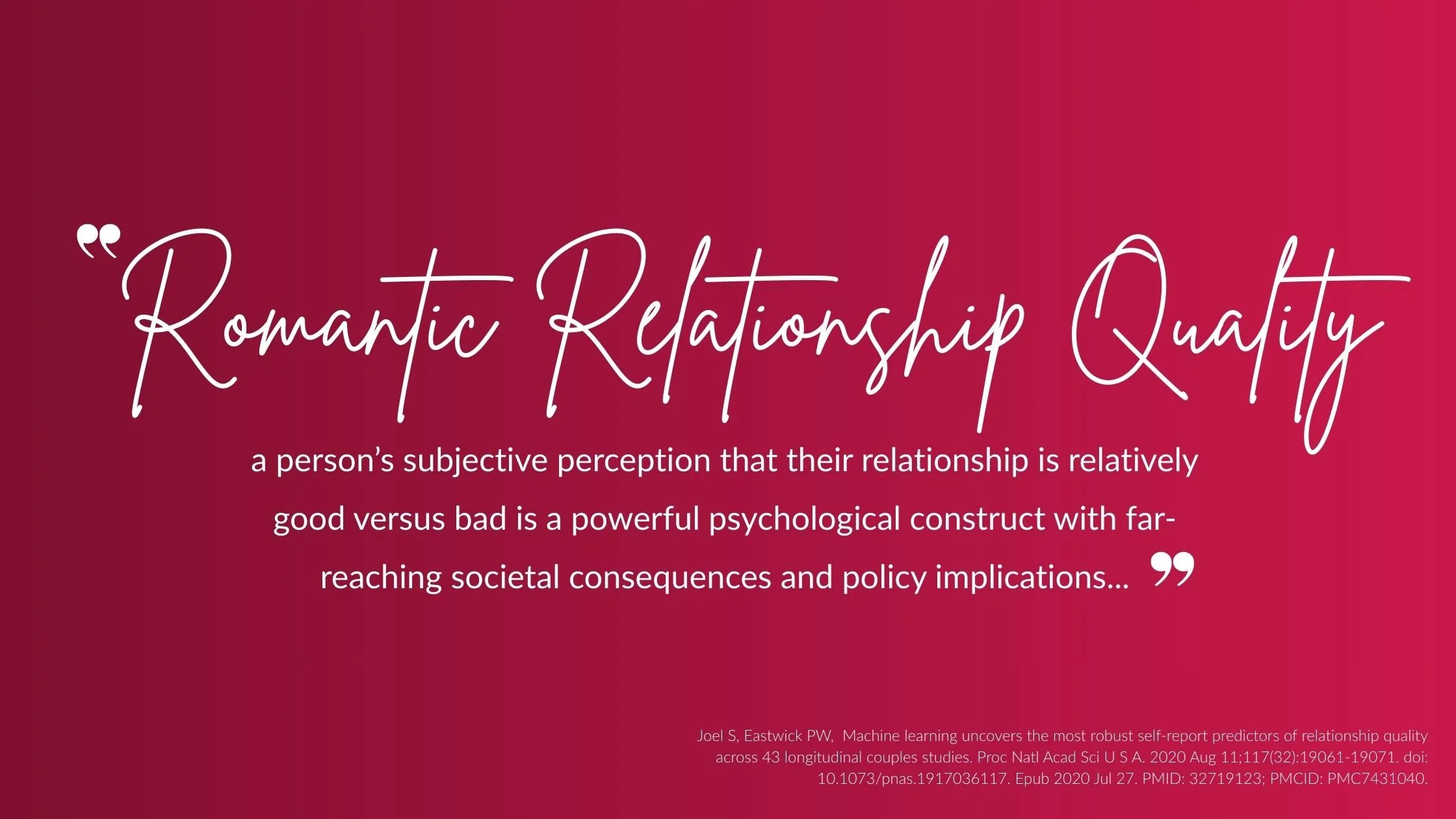
And here’s the twist: one of the strongest messages from relationship science is that your lived experience matters, not the “public story” of your relationship.
The 5 strongest predictors of relationship quality
In the episode with Dr. Bobby, our very own Dr. Merideth describes a pivotal meta-analytic/machine-learning project led by relationship scientist Samantha Joel, and the results are striking.
Across 43 longitudinal couples datasets from 29 research labs (representing 11,196 romantic couples), the most robust relationship-specific predictors of relationship quality were:
Perceived partner commitment
Appreciation (how much you appreciate your partner)
Sexual satisfaction
Perceived partner satisfaction
Conflict (How often you have fights with your partner)
Even more clarifying: in that project, relationship-specific variables predicted about 45% of the variance in people’s current relationship satisfaction at baseline.
In other words, while relationships are complex, there are definite, proven factors that determine whether a relationship is high-quality and likely to continue over time.
Let’s dive deeper into each factor

1) Perceived Partner Commitment
Research consistently shows that your perception of your partner’s commitment is one of the strongest predictors of how good the relationship feels.
Perceived Partner Commitment is your sense of how invested your partner is in your relationship. Do they intend to stick around, choose the relationship, and build a future with you? It shows up as signals of priority (they factor you into decisions), persistence (they work through conflict), and future orientation (they make “we” plans).
Why this matters
PPC sits at the heart of security. When we believe our partner is committed, everyday irritations feel smaller, repairs land faster, and cooperation gets easier. In plain English: the clarity of “Are you in with me?” matters—a lot.
At a process level, PPC connects to trust, responsiveness, and understanding: feeling understood softens conflict, and responsive care builds the felt safety that undergirds commitment (Gordon & Chen, 2016; Maisel & Gable, 2009). Over time, reliable signals of commitment support “relationship maintenance” behaviors—the everyday choosing of each other (Rusbult, 1998; Gordon et al., 2012).
How this affects ambivalence
Ambivalence can form when your partner’s long-term commitment is in doubt, inconsistent or hard to trust.
If you don’t feel like they are in it for the long haul, then why should you be?
If you don’t feel secure in their commitment, your nervous system stays on alert: Is this relationship stable? Am I wasting time? Am I going to be abandoned?
But if there are enough signs of commitment (or occasional reassurance), you keep thinking: Maybe it’s fixable. Maybe I’m overreacting.
Here are a few things you might be thinking:
“They say they want this… but their actions don’t match.”
“They’re committed when it’s easy, not when it’s hard.”
“If I stop trying, the relationship collapses.”
Dr. Merideth’s guidance is basically an antidote to commitment-confusion:
“Pay attention, not to what the person says, but to what they do… lip service is super easy.”
Reality-check questions:
Do their choices match the future they talk about?
When life gets hard, do they lean in or disappear?
If you stopped “holding it together,” would they step up?

2) Appreciation of Your Partner
Appreciation of Partner is the habit of noticing, valuing, and explicitly acknowledging your partner’s qualities, efforts, and positive impact—both in big moments and in small, everyday ways. It blends an inner stance (“I see your goodness”) with outward signals (specific thanks, admiration, and supportive responses to your partner’s good news).
In the science of close relationships, appreciation overlaps with gratitude processes that “find, remind, and bind” partners to one another and with perceived partner responsiveness—the sense that your partner “gets you,” cares about your needs, and shows up accordingly [Algoe, 2012; Reis & Shaver, 1988; Maisel & Gable, 2009].
Why this matters
Across the 43 longitudinal couples datasets, appreciation emerged among the most reliable, relationship‑specific predictors of how satisfied people feel in their relationships. Translation: the “climate” you create by seeing and naming each other’s contributions matters—a lot.
Appreciation also strengthens the system that keeps couples close: gratitude helps partners maintain and invest in the bond; feeling understood buffers the sting of conflict; and responsive support lands better than generic help [Algoe, 2012; Gordon et al., 2012; Gordon & Chen, 2016; Maisel & Gable, 2009]. Because relationship quality is tied to broader health and well‑being, building appreciation isn’t just good for “us”—it’s good for you too.
How this affects ambivalence
Appreciation is what makes leaving feel like loss even when staying feels painful.
If you can still see their strengths, their humanity, their good intentions, it’s much harder to land on “I’m done.”
Appreciation can generate guilt: Am I being too harsh? What if I regret leaving someone who isn’t all bad?
It can also create the “mixed-bag” problem: They’re a great parent / provider / friend… but I feel lonely or unsafe or unseen.
Ambivalence tends to spike when appreciation exists alongside chronic disappointment.
Here are a few things you might be thinking:
“They’re wonderful in public, but at home it’s different.”
“They have good qualities… why can’t I be happy?”
“If I leave, I’m afraid I’ll be throwing away something valuable.”
Appreciation is often the emotional glue that keeps people in, maybe longer than they want to be.
Reflection questions:
Can you still see the good in them consistently, not just on “good days”?
Do you feel proud to be their partner?
Do you like who you are when you’re with them?

3) Your Sexual Satisfaction
Sexual satisfaction is your felt sense of contentment with the sexual part of your relationship—how pleasurable, connected, comfortable, and “right” it feels for you (not just frequency). It includes body comfort and pleasure, emotional safety, alignment with your values and boundaries, and whether intimacy meets your needs. In a pooled analysis of 43 longitudinal studies (11,000+ couples), sexual satisfaction emerged as one of the most robust self‑report predictors of overall relationship quality.
Why this matters
When sexual satisfaction is higher, couples tend to feel closer, more appreciative, and less tense.
Sexual satisfaction is also among the top robust predictors of relationship quality in the same large synthesis.
This doesn’t mean “everything depends on sex.” It means sex is often a signal for deeper dynamics: emotional safety, feeling desired, trust, playfulness, acceptance, repair after conflict.
How this affects ambivalence
Sexual satisfaction can pull you toward staying because it’s one of the most visceral signals of connection. But it can also push you toward leaving when it drops — or create confusion when it’s “good sometimes.”
If the sex is good (or chemistry is strong), people often think: Maybe that means we’re meant to be together.
That can override serious emotional problems for a long time.If the sex is bad or absent, people often wonder: Is this just a phase? Is it stress? Is it fixable? Or is this the real relationship?
When emotional safety is shaky, sex can become a “barometer” — and barometers fluctuate. That fluctuation can create ambivalence.
Here are a few things you might be thinking:
“We fight a lot, but we still have chemistry.”
“I love them, but I don’t want them.”
“Sometimes it’s great… and sometimes I feel shut down.”
Sex is rarely just sex in ambivalence — it’s often a proxy for safety, closeness, resentment, or repair.
Reflection questions:
Do you feel safe (emotionally and physically) with them?
Do you feel wanted—and able to want them?
Is intimacy something you can talk about without it turning into shame, pressure, or shutdown?

4) Perceived Partner Satisfaction
Perceived Partner Satisfaction is your best guess about how happy and fulfilled your partner feels in the relationship right now. It’s a meta‑perception—formed from what they say and do (affection, complaints, engagement) and what you infer between the lines. It isn’t always the same as their actual satisfaction, but it strongly shapes how secure and generous you feel with them.
Why this matters
What you believe about your partner’s happiness sets the emotional climate. When you think “they’re doing well with us,” you relax, take pro‑relationship risks (vulnerability, planning), and read ambiguous moments more kindly. When you think “they’re unhappy,” anxiety and defensiveness rise—people over‑monitor, withdraw, or over‑function—often creating the very tension they fear.
Because partners influence each other, accurate, compassionate read‑outs help both of you: you’re more likely to turn toward bids, offer responsive support, and collaborate on fixes. Misreads do the opposite—either complacency (“I thought we were fine…”) or chronic worry (“I can’t do anything right”), both of which erode connection and personal well‑being over time.
How this affects ambivalence
When you believe your partner isn’t satisfied, your brain starts running two competing narratives at once:
This relationship is unstable — I should protect myself.
Maybe I can fix this — I should try harder.
That creates a “performance trap” where you’re constantly scanning them for signs of satisfaction and adjusting yourself to keep the relationship afloat. That can keep someone stuck in ambivalence for a long time, because the goal becomes stability rather than health.
Ambivalence patterns this shows up as:
“If I could just do it better, they’d be happy.”
“They’re unhappy… but they haven’t left.”
“I don’t know if they still want me.”
“People don’t change until they want to change… We need to keep our eyes on our own paper.”
Reflection questions:
Do you feel like you’re always “failing” them, even when you’re trying?
Do they act like they want to be in this relationship?
Is there a stable foundation—or constant threat of withdrawal, criticism, or contempt?
5) Conflict
Conflict happens. And sometimes conflict can escalate; this measure is about how easily it happens, how intense it gets, and how quickly you two can slow it down and repair.
It’s not “Do you ever fight?” It’s what conflict does to the relationship: Does it lead to resolution, respect, and repair… or does it spiral into contempt, shutdown, and chronic distance?
Too much conflict leads to decreased relationship quality and increased ambivalence. Tones harden. Volume rises. Blame is thrown back and forth. Past grievances and tangents get piled on until you’re talking about nothing and everything all at once.
In high-conflict relationships, it’s easy to fall into a pattern. Each negative move invites a stronger negative counter‑move (criticism → defensiveness → contempt → stonewalling), so the conversation becomes about winning or protecting yourself rather than understanding and solving.
Why this matters
When conflict escalates, partners feel less understood and less cared for, which erodes trust, intimacy, and commitment over time. Even strong relationships can be worn down if most disagreements spin into “us vs. each other” instead of “us vs. the problem.” Repeated escalation also trains the nervous system to anticipate threat with your partner, making future disagreements more volatile.
Personally, chronic escalation is exhausting: it spikes stress hormones, disrupts sleep, and can fuel anxiety or low mood. It also steals energy from the rest of life (work, parenting, friendships). In contrast, being able to keep hard conversations emotionally safe and contained is one of the most reliable building blocks of long‑term satisfaction, resilience, and health.
“High-conflict situations… disagreements that are really disrespectful, draining, destructive, or that never really get solved…”
How this affects ambivalence
That matters for relationship ambivalence because ambivalence often forms in the exact space conflict creates:
You have real reasons to stay (good moments, history, shared life).
You also have real reasons to doubt (you keep hitting the same painful wall, and it’s eroding your hope).
From a clarity standpoint, notice how that kind of conflict doesn’t just feel unpleasant—it creates uncertainty:
“If we can’t resolve anything… what am I building my future on?”
A research-grounded nuance that helps: conflict is broad, and it’s consistently predictive
In the PNAS paper’s construct success table, broad conflict measures showed strong, consistent predictive usefulness across datasets, while more specific “conflict strategies” measures were notably less consistent. PMC
Ambivalence patterns this shows up as:
“I can’t even diagnose how we fight… I just know I feel worse, and nothing changes.”
“How can we fight at everything and nothing at the same time?”
“How did explaining my hurt or frustration turn into a conversation about their hurt and frustration instead?”
“Am I just too ungrateful, emotional, crazy, high-maintenance, clingy, etc?”
Reflection questions:
Does conflict end in repair or in punishment?
(Repair can be a hug, a clean slate, a real plan, a sincere apology that changes behavior.)Do disagreements produce solutions—or only “evidence” that you’re alone?
After conflict, do you feel safer and closer… or more guarded and small?
Are there patterns of contempt, cruelty, intimidation, threats, or stonewalling?
That’s not toxic positivity. It’s a concrete description of repair.
If your conflicts never move toward repair—if they consistently create fear, instability, or emotional unsafety—ambivalence often isn’t “indecision.” It’s your nervous system accurately tracking risk.
Honorable Mention: Perceived Partner Responsiveness
This research paper also strongly emphasizes perceived partner responsiveness—the felt sense that your partner “gets you,” values you, and shows up for you. (PMC)
The Gottmans famously studied “bids” for connection—small attempts to connect during everyday life. In one summary of their longitudinal work, couples who later divorced made bids 33% of the time, while couples who stayed together made bids 86% of the time. (The Gottman Institute)
Reflection questions:
When you reach, do they respond (most of the time)?
Do you feel emotionally alone inside the relationship?
Are you both still trying to build friendship—day by day?
The most empowering insight: your experience is the data
One of the most validating findings from the large relationship-quality project is that people’s own reports of their relationship experiences carry the most predictive power—more than partner reports or broad personality traits.
That matters when you’ve been gaslit by a dynamic, minimized by friends/family, or internally trained to doubt yourself.
The Clarity Matrix: a practical way to sort what’s yours to carry (and what isn’t)
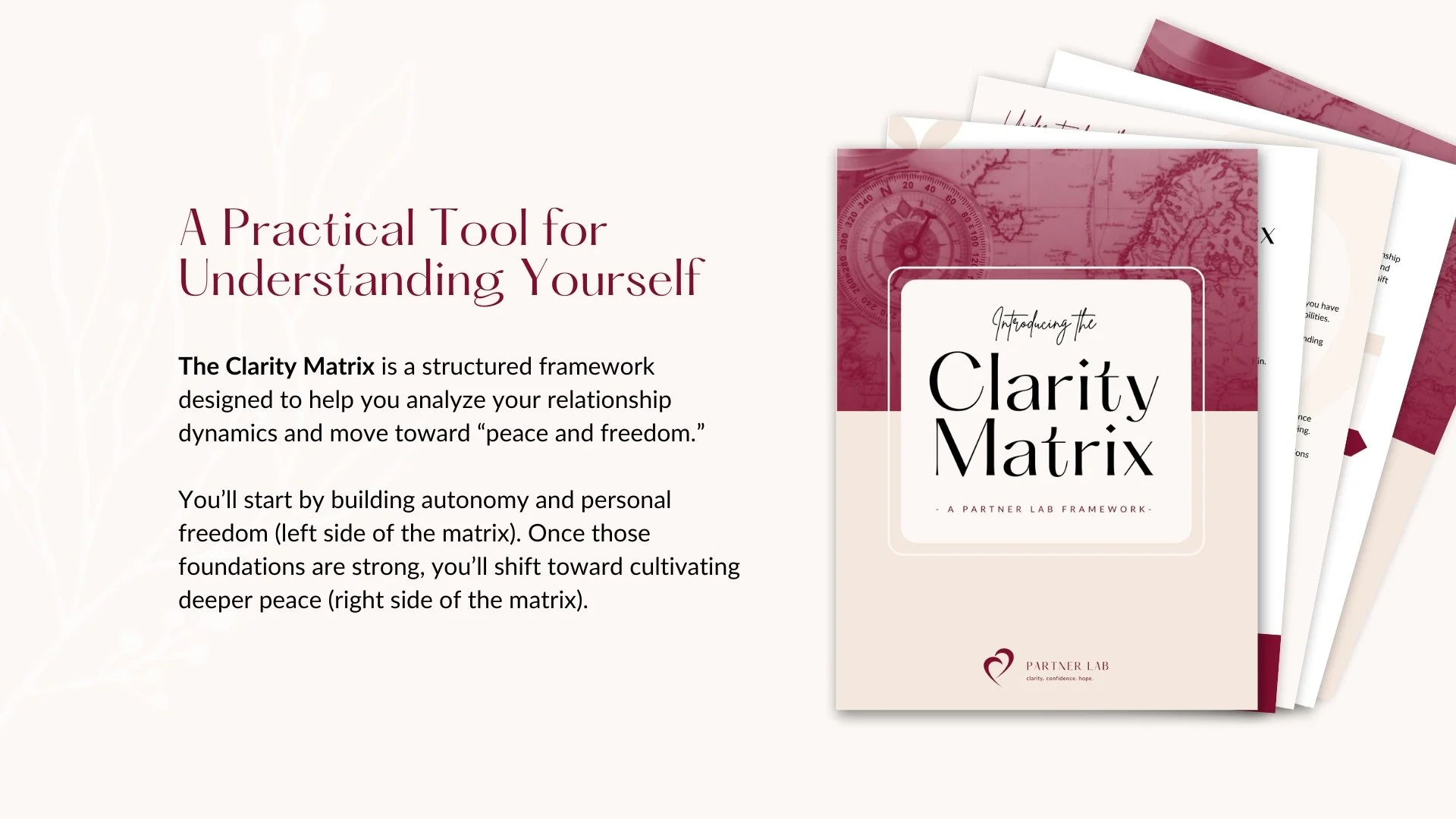
Dr. Merideth describes a framework she calls the Clarity Matrix—a four-quadrant way of mapping what you can control or influence, and whether it’s helping or harming you.
Here’s the essence (translated into everyday terms):
Low control + high harm: recognize dealbreakers and protect yourself
High control + high harm: claim freedom through boundaries, truth-telling, and self-trust
Low control + positive potential: stop policing your partner; focus on what’s real (not what you hope)
High control + positive impact: “grow your peace” through choices that build stability and well-being
A NOTE: about abuse, coercion, and financial control
If anything in your relationship includes intimidation, threats, coercive control, or abuse, clarity starts with safety.
The CDC reports intimate partner violence is common: about 41% of women and 26% of men experience contact sexual violence, physical violence, or stalking by an intimate partner in their lifetime (with related impacts). (CDC)
And financial abuse is often part of the picture. A 2025 NNEDV fact sheet reports that financial abuse occurs in 99% of domestic violence cases—and that 78% of Americans (in a 2014 study) did not recognize financial abuse as domestic violence.
If you need immediate support, you can contact the U.S. National Domestic Violence Hotline at 1-800-799-SAFE (7233) (and additional options exist for chat/text). (Department of Justice)
“Can this get better?” Yes—when two things are true
Dr. Lisa and Dr. Merideth both emphasize a critical point:
Motivation matters. But skills matter too.
When both partners are willing, relationship counseling and couples therapy can be meaningfully effective. A 2020 meta-analysis of couple therapy (58 studies; 2,092 couples) found large improvements in relationship satisfaction from pre- to post-therapy (Hedges g ≈ 1.12), while waitlist couples showed little change. (PubMed)
Still, the episode offers a grounded warning:
“Insight isn't enough… There really does need to be follow-through… Action, not words.”
—Dr. Lisa Marie Bobby & Dr. Merideth Thompson
So a powerful clarity question becomes: Do we both want this—and are we both acting like it?
“Partner Lab’s tagline is clarity, confidence, hope. ’Cause you can’t have confidence until you have clarity, you can’t have hope until you have confidence.”
Conclusion: your next best step toward clarity
If you’re tired of living in “maybe,” consider taking a step that turns fog into feedback.
Clarity360 is Partner Lab’s deep-dive relationship wellness assessment designed to give you a more objective picture across 20+ areas of relationship health, along with a relationship scorecard, strength and growth areas, and a personalized action plan you can use on your own or share with a partner, therapist, or coach.
If you’re ready to stop guessing and start grounding your next steps in research-backed clarity, start here:
https://www.mypartnerlab.co/clarity360
